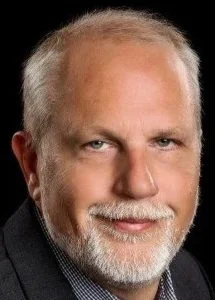
Written By: Frank Saulsbery

THE LATEST THOUGHTS FROM THE FOUNDER
A running column from Frank Saulsbery. Not a sales pitch, just the way he’d explain it if you pulled up a stool next to him. Meet Frank →
A SNEAK PEEK…
“Most business owners aren't looking for the biggest provider. They're looking for the right provider.”
It's a fair question. Maybe you've met with a very small IT company where one or two people seem to handle everything. On the other hand, you've probably talked with larger providers that have dozens of employees. It can be hard to know what size actually makes sense for your business.
Most business owners aren't looking for the biggest provider. They're looking for the right provider. They want to know that when something goes wrong, someone will answer the phone, solve the problem, and help keep the business running.
The reality is that IT today is much more complicated than it was even a decade ago. It's no longer just fixing computers when they break. There are security checks to perform, backups to monitor, software updates to manage, passwords to protect, systems to document, and a long list of tasks that need to happen daily, weekly, and monthly.
That's why company size matters. In my experience, it's very difficult for a managed service provider to operate efficiently with fewer than five employees. That doesn't mean a smaller company is bad or incapable. There are talented people running very small IT businesses, the challenge is that there's simply a lot to juggle.
Think about everything that has to be done behind the scenes. Someone needs to monitor security alerts. Someone needs to verify backups are working. Someone needs to handle support tickets. Someone needs to keep systems updated. Someone needs to work on projects and improvements.
When only one or two people are responsible for all those tasks, everything depends on those individuals having enough hours in the day. Eventually, something gets delayed because there just isn't enough bandwidth.
Once a provider reaches five or more employees, they can begin creating some specialization. One person may focus more on support. Another may concentrate on security. Someone else may oversee backups, projects, or client relationships. The work becomes more organized and consistent.
But company size by itself doesn't tell the whole story. A question I think business owners should ask is, how many devices is each technician responsible for? In the managed services world, we often refer to those devices as endpoints. That simply means computers, servers, laptops, and other systems being managed.
Let's say a five-person IT company is managing 2,000 endpoints. On paper, five employees may sound adequate. But if you do the math, that's roughly 400 endpoints per employee. Most business owners immediately recognize that sounds like a pretty heavy workload.
A better measure is how many endpoints each full-time technician supports. A healthy range is often somewhere between 150 and 300 endpoints per technician dependent on efficiency. That isn't a magic number, but it provides a useful benchmark.
It's also important to understand that we're talking about dedicated technicians. If someone is splitting their time between technical work, project management, sales meetings, client management, and other responsibilities, their available support capacity is lower than someone spending eight hours a day focused on supporting clients.
This matters because overloaded technicians usually lead to slower response times, less proactive work, and more things slipping through the cracks. Not because they don't care, but because there are only so many hours in the day.
On the other hand, bigger isn't always better either. A large provider with layers of management and high technician loads may not necessarily deliver a better experience than a smaller provider with strong processes and a well-balanced team.
The goal isn't finding the largest IT company. The goal is finding one that has enough people, enough specialization, and enough capacity to properly support your business.
If you're talking with a provider and trying to determine whether they're a good fit, ask some simple questions. How many employees do you have? How many technicians are dedicated to support? How many endpoints does each technician manage? Are you actively hiring as your client base grows? Those answers can tell you a lot about whether the company is positioned to provide consistent service over the long term.
At the end of the day, technology support is a lot like any other professional service. You want a team with enough depth that one person's vacation, illness, or busy week doesn't impact your business.
So here's a simple question to consider: if your business had a major technology issue tomorrow, would your provider have enough people and enough capacity to respond quickly and effectively? It's worth asking. The answer may tell you more than the provider's employee count ever could.
That’s how I see it, anyway, and I’d enjoy hearing how you see it. None of this is a sales pitch. It’s just the kind of thing I’d talk through with you if we were sitting across the table. If it raised a question, or you think I have it wrong, I want to hear about it.
My door is always open. Whether you want to talk this through or just say hello, you can reach me anytime.
Network Solutions Unlimited is a generational managed IT services provider based in Decatur, Illinois, serving businesses and nonprofits with genuine support and decades of trusted relationships. Led by Baily Saulsbery and founded by her father Frank, we're not just your IT provider; we're your neighbors who happen to be really good at technology. Contact us today to experience IT support that actually cares.