Understanding Zero Trust Security
Written By: Frank Saulsbery
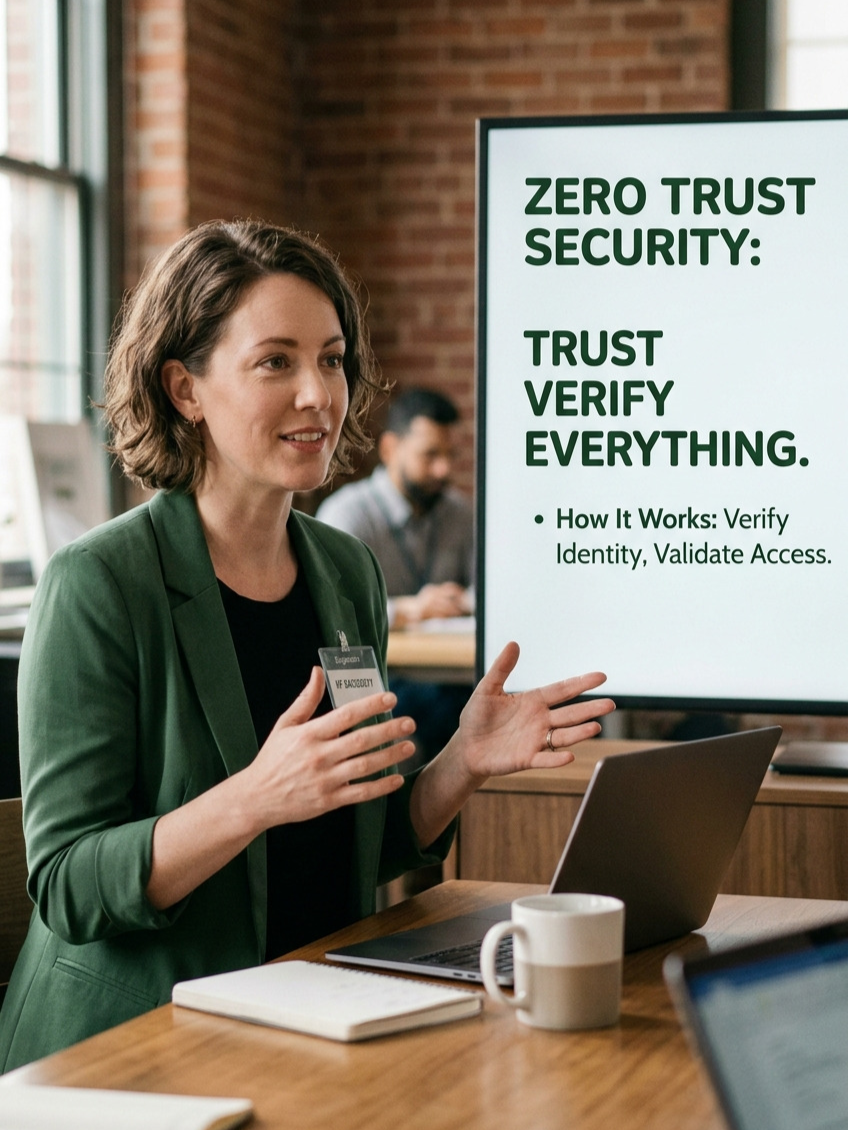
You have probably seen the phrase zero trust turn up in security conversations, vendor pitches, and even insurance requirements. It sounds a little cold, maybe even paranoid. In reality, it describes one of the most sensible shifts in how businesses protect themselves, and the idea behind it is refreshingly simple once you strip away the jargon.
The old way of thinking about security treated your network like a castle with a strong wall around it. Anyone inside the wall was trusted; anyone outside was not. Zero trust throws out that assumption, because the modern workplace no longer has a tidy wall to defend. In this post, we will explain what zero trust actually means in plain language, how its core ideas work together, and what adopting it looks like for a real business rather than a Fortune 500 headquarters.
What Zero Trust Actually Means
At its heart, zero trust is a security approach that says: never assume trust, always verify. Instead of trusting a user or device simply because it is inside your network, a zero trust model checks every request for access, every time, no matter where it comes from.
That does not mean your systems become hostile or hard to use. It means that access is granted based on proof rather than location. A person logging in from their desk gets the same scrutiny as someone logging in from a coffee shop, because in today's world, either one could be legitimate or either one could be an attacker using stolen credentials. Building this kind of thoughtful verification is exactly the sort of thing our cybersecurity services are designed to help organizations put in place.
Why the Old Model Stopped Working
For years, the castle-and-wall approach made sense because work happened in one place. Everyone sat in the office, on the company network, using company devices. Protecting the perimeter protected the business.
That world is gone. Today your team works from home, from the road, and from personal devices, and your data lives in cloud applications that sit far outside any wall you could build. The rise of remote and hybrid work means the old perimeter has essentially dissolved, and attackers have learned to take advantage of that.
The bigger problem with the old model is what happens once someone gets inside. In a trust-the-inside approach, a single stolen password can give an attacker the run of your network, because everything inside the wall trusts everything else. Zero trust closes that door by refusing to hand out that kind of blanket trust in the first place.
This shift matters because of how modern attacks actually unfold. Most serious breaches do not begin with someone smashing through your firewall. They begin with a stolen login, a convincing phishing email, or a compromised device that walks right through the front door looking perfectly legitimate. Once inside a trust-based network, the attacker moves quietly from system to system. Zero trust is built specifically to stop that quiet movement, checking each step instead of waving it through.
The Core Principles of Zero Trust
Zero trust is not a single product you buy. It is a set of principles that work together, and most businesses already have pieces of it in place without calling it by name. Understanding these principles helps you see how the parts fit and where your own gaps might be.
Here are the ideas that make zero trust work:
Verify every user and device before granting access, rather than trusting anything by default.
Grant the least access necessary, so people and systems can reach only what their job actually requires.
Assume a breach is possible and design your systems to limit the damage if one occurs.
Monitor continuously, because a session that was safe a minute ago may not be safe now.
Segment your network so that a problem in one area cannot spread freely to the rest.
None of these ideas is exotic. Together, they form a defense that is far harder to defeat than a single wall, because getting past one layer no longer means getting past all of them.
How Zero Trust Comes to Life
Principles are helpful, but you may be wondering what zero trust looks like in the tools and settings your business actually uses. The good news is that adopting zero trust is usually a matter of strengthening and connecting protections you may already have rather than starting from scratch.
Here are the building blocks that turn zero trust from a concept into a working defense.
1. Strong Identity Verification
Everything in zero trust begins with knowing who is really requesting access. That means going beyond passwords, which are stolen and reused constantly.
Multi-factor authentication is the practical foundation here, requiring a second proof of identity so that a stolen password alone is useless. It is often the single most impactful step a business can take toward a zero trust posture.
2. Device Trust and Health
Zero trust cares not just about who is asking, but about what device they are asking from. A verified user on a compromised laptop is still a risk.
Strong endpoint security lets you confirm that a device is protected and up to date before it connects to sensitive systems. A device that fails those checks can be blocked or limited until it is brought back into a safe state.
3. Least-Privilege Access
The principle of least privilege means giving each person and system only the access they truly need, and nothing more. If someone does not need access to your financial records to do their job, they should not have it.
This dramatically limits what an attacker can reach even if they do get in. Reviewing and tightening access is often quiet work, but it is some of the most valuable security work a business can do.
4. Network Segmentation
Rather than one big open network, zero trust favors dividing your environment into smaller zones with controlled connections between them. This is the idea behind protecting your most sensitive data with network segmentation.
Segmentation means that even if an attacker breaches one area, they hit walls trying to move anywhere else. Combined with strong network security, it keeps a small incident from becoming a company-wide crisis.
5. Continuous Monitoring and Response
Zero trust assumes that something will eventually slip through, so it never stops watching. Continuous monitoring looks for unusual behavior and responds before a small anomaly becomes a serious breach.
Active threat management provides the eyes and the rapid response that make this work. The goal is to catch and contain problems in minutes rather than discovering them weeks later.
Put these building blocks together and you have a defense that verifies, limits, and watches at every step rather than relying on a single point of protection.
Zero Trust Is for Small Businesses Too
There is a common misconception that zero trust is only for large enterprises with big budgets and dedicated security teams. That is not true, and believing it can leave a smaller organization dangerously exposed. Attackers target businesses of every size, and smaller organizations are often chosen precisely because they assume they are too small to bother with.
The reality is that zero trust scales down gracefully. A small nonprofit does not need the same infrastructure as a regional bank, and a good partner will right-size the approach to your actual risk, budget, and how your team works. Much of what makes up zero trust, from multi-factor authentication to cloud protection, is well within reach for organizations of any size. Our cloud security work is a good example, extending zero trust principles to the applications your team relies on every day.
Adopting these protections also tends to be less disruptive than people expect. Done well, zero trust runs quietly in the background, verifying and monitoring without slowing your team down or forcing them through constant hurdles. The occasional extra login prompt is a small trade for knowing that a stolen password or a lost laptop will not hand an attacker the keys to everything. When the balance is set correctly, your people barely notice it, and that is exactly the point.
Taking the First Step Toward Zero Trust
Moving toward zero trust does not have to be a giant leap. It is a direction rather than a destination, and most businesses get there one sensible step at a time, starting with strong identity verification and tightening access from there. The important thing is to begin, because the old castle-and-wall thinking leaves gaps that today's threats are built to exploit.
We believe security should protect your mission without getting in the way of your work, and we explain every step in plain language so you always understand what we are doing and why. If you are ready to explore what a zero trust approach could look like for your organization, our IT consulting team would be glad to help. Get in touch and let us build a defense that fits the way your business really works.
Network Solutions Unlimited is a generational managed IT services provider based in Decatur, Illinois, serving businesses and nonprofits with genuine support and decades of trusted relationships. Led by Baily Saulsbery and founded by her father Frank, we're not just your IT provider; we're your neighbors who happen to be really good at technology. Contact us today to experience IT support that actually cares.